
Oct 4, 2026Applications
Chrome Plating on Plastic: How It Works
Plastic can be chrome-plated — after etching, activation and autocatalytic nickel. See the full process chain and the line equipment behind decorative plastic plating.
Plastic becomes chrome-ready through a chemical chain — etch, activate, autocatalytic nickel — and only then does electroplating take over. About a 6-minute read.
Written by Nick Wong · Engineering reviewed by Li Wang · Published 4 October 2026 · Updated 4 October 2026
Chrome-look plastic parts — automotive grilles, trim, appliance hardware — are real electroplated coatings, not paint. The trick is making a non-conductive surface conductive first. That pre-chain is where plating on plastics differs from metal-on-metal work.
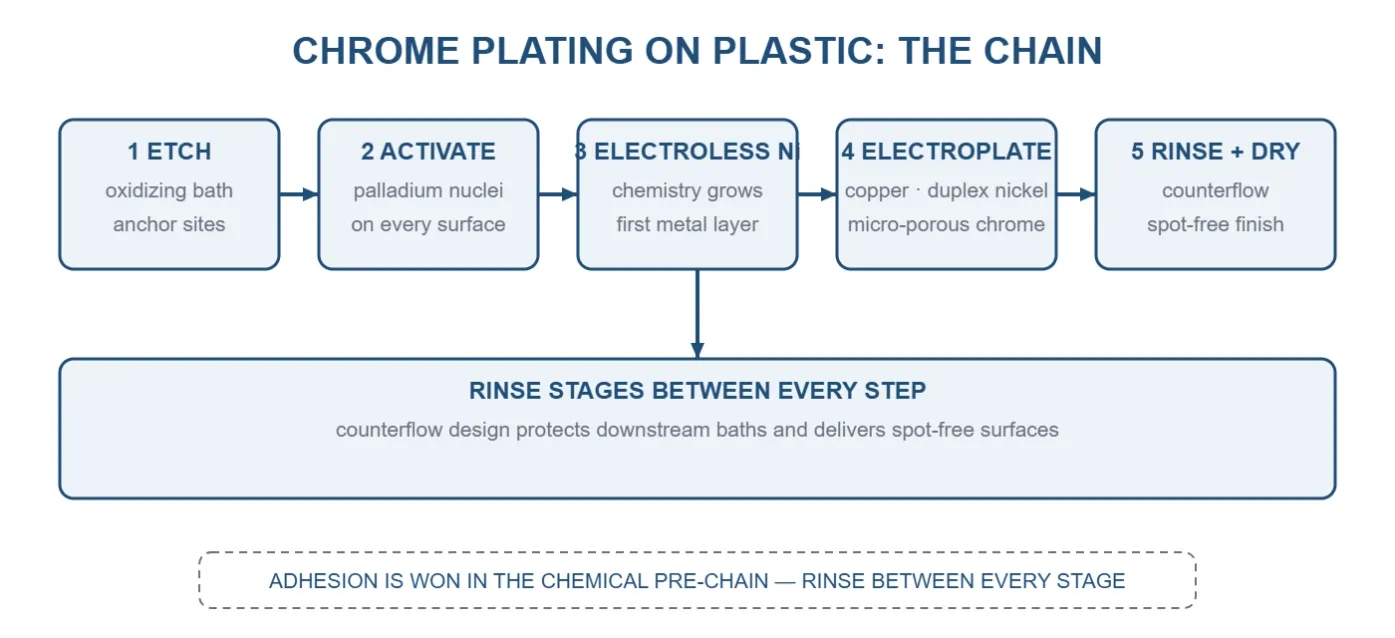
The Process Chain
- Moulding discipline — the chain starts at the injection-moulding machine: plateable grades (classically ABS or ABS/PC blends), clean tooling, release agents that the etch can remove. Stress in the moulding shows up as adhesion failures after plating.
- Etching — a strongly oxidizing bath micro-etches the surface, creating the anchor sites adhesion needs.
- Neutralizing / preconditioning — stops the etch and conditions the surface for activation.
- Activation (palladium-based) — deposits catalytic nuclei across the etched surface.
- Acceleration — exposes the catalytic sites properly.
- Autocatalytic (electroless) nickel or copper — chemistry, not current, grows the first continuous metal layer. The plastic is now conductive.
- Electroplating — from here it is classic plating: copper strike/build for leveling, duplex nickel for corrosion, and micro-porous chromium for the final bright, corrosion-resistant finish.
- Rinsing throughout — every step above is separated by rinse stages, with counterflow design protecting downstream baths.
Specifications such as ASTM B604 (decorative copper + nickel + chromium on plateable plastics) define the grade systems, and ASTM B727 covers preparing plastics for electroplating — the two anchors buyers most often cite.
What the Line Includes
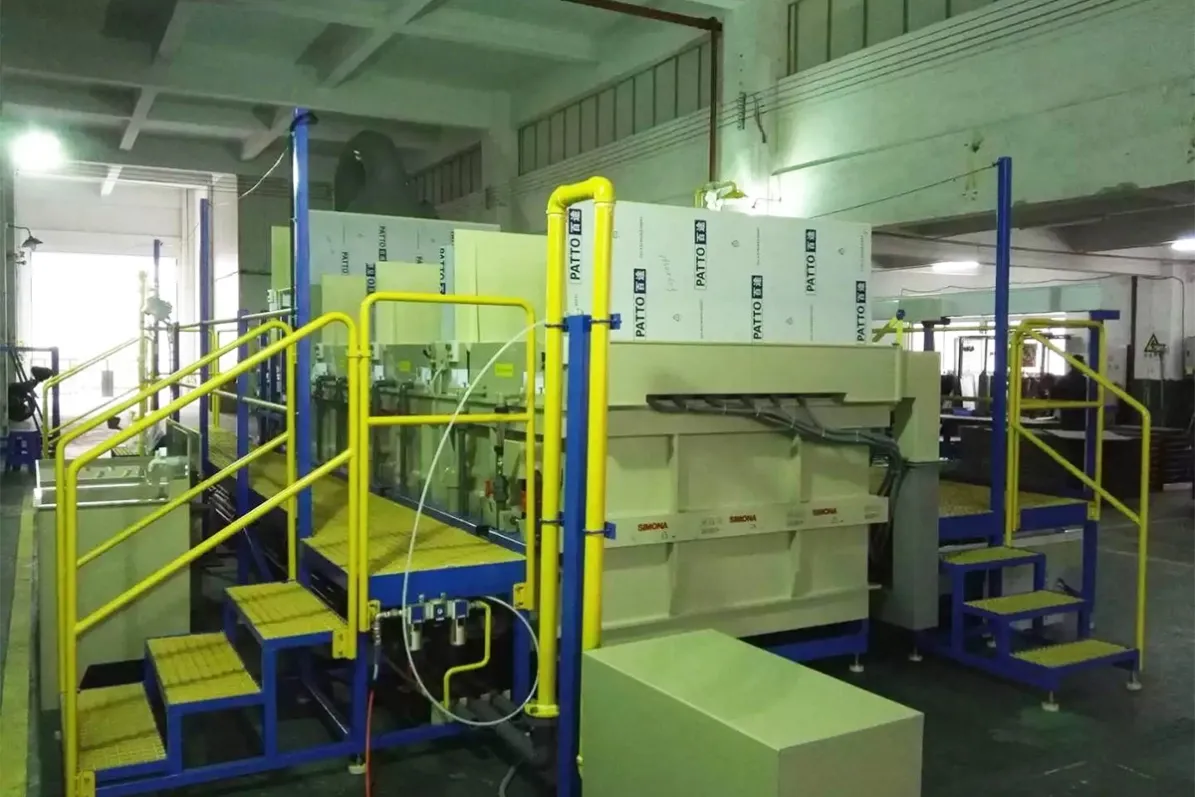
A plastics line is a plating line with a longer chemical pre-chain: etch and activation tanks with tight temperature and concentration control, autocatalytic cells, then the electroplating section — all with the rinse discipline of the electroplating process. Control matters more than in metal work: the pre-chain runs on chemistry windows where drift shows up as adhesion loss or skip-plate defects. Handling is gentle — racks designed for plastic geometries, and automation that keeps dwell times exact. The platform view is under plating lines.
Field Workflow: Readiness Checklist for Plated Plastic
- ☐ Plateable grade confirmed (ABS / ABS-PC), moulding stress reviewed
- ☐ Adhesion test method agreed (and thermal-cycling requirement)
- ☐ Coating grade called out per the applicable plastics-plating specification
- ☐ Rinse and wastewater scope sized for the etch and activation chemistry
- ☐ Rack geometry planned with the part family, not after it
Standards and Evidence Boundary
- ASTM B604 — standard specification for decorative electroplated coatings of copper plus nickel plus chromium on plastics — ASTM International.
- ASTM B727 — standard practice for preparation of plastics for electroplating — ASTM International.
- ISO 2080 — electroplating and related processes: vocabulary.
Evidence boundary: this article explains the process chain at industry-general level. Chemistry systems, bath windows and acceptance tests come from the chemistry supplier and the applicable specifications — not from this page.
FAQ
Does the chrome layer make the part strong?
No — the coating is micrometres thin; the plastic carries the load. Plating changes surface function (appearance, corrosion, some abrasion resistance), not structure.
Why duplex nickel and micro-porous chrome?
Corrosion: the duplex nickel structure and micro-porous chrome spread and slow corrosive attack, which is what the grade systems in the specifications encode.
Can all plastics be plated?
No — plateable grades are formulated for the etch/activation chain (ABS family is the classic). Other polymers need special treatment or are unsuitable.
What fails most often?
Adhesion — nearly always traceable to moulding stress or pre-chain drift. The checklist above exists to catch both early.
Related Reading
- Pillar guide: What Is Electroplating? — the deposition fundamentals the chain ends in.
- Process detail: The Electroplating Process, Step by Step — the electroplating half of the chain.
- Next step: browse plating lines to discuss line concepts.
Diagnostic CTA: What to Send Us — and What You Get Back
Send three inputs through our RFQ form:
- The plastic part family and grade (ABS/ABS-PC), geometry and rack plan
- The finish grade and corrosion requirement the spec calls out
- Throughput and current process status
ES-PRO returns: a line concept covering the chemical pre-chain and electroplating section, an equipment list, a quotation, and an explicit list of open questions — we state what is missing rather than assuming it.
References & Authorities
- ASTM B604 — Standard specification for decorative electroplated coatings of copper plus nickel plus chromium on plastics — ASTM International.
- ASTM B727 — Standard practice for preparation of plastics for electroplating — ASTM International.
- ISO 2080 — Electroplating and related processes: vocabulary — International Organization for Standardization (ISO).
- Chemistry supplier datasheets — etch, activation and plating bath systems and windows (issued by the chemistry supplier).
- Industry associations — e.g., NASF (National Association for Surface Finishing, US) and IMF (Institute of Materials Finishing, UK) publish supplementary guidance and training for the surface-finishing industry.
- Standards are cited for identification; always use the current edition from the issuing body. Process parameters are governed by the datasheets for the specific chemistry.