
Oct 3, 2026Ultrasonic Cleaning
How Ultrasonic Cleaners Work: Cavitation Explained
Ultrasonic cleaners use cavitation bubbles to remove contamination. See how frequency, heat and cleaning chemistry work together in industrial tanks.
A practical guide for workshop and maintenance leads — what cavitation does, how frequency and power change the result, and what an industrial machine includes. About a 7-minute read.
Written by Mia Shang · Engineering reviewed by Li Wang · Published 2 October 2026 · Updated 2 October 2026
An ultrasonic cleaner works by using high-frequency sound waves in a liquid to create millions of microscopic bubbles that collapse against submerged parts — a process called cavitation. Each collapse releases a microscopic jet of energy that lifts oil, chips and contamination off surfaces and out of blind holes — without scrubbing or disassembly.
The Principle: Cavitation, Step by Step
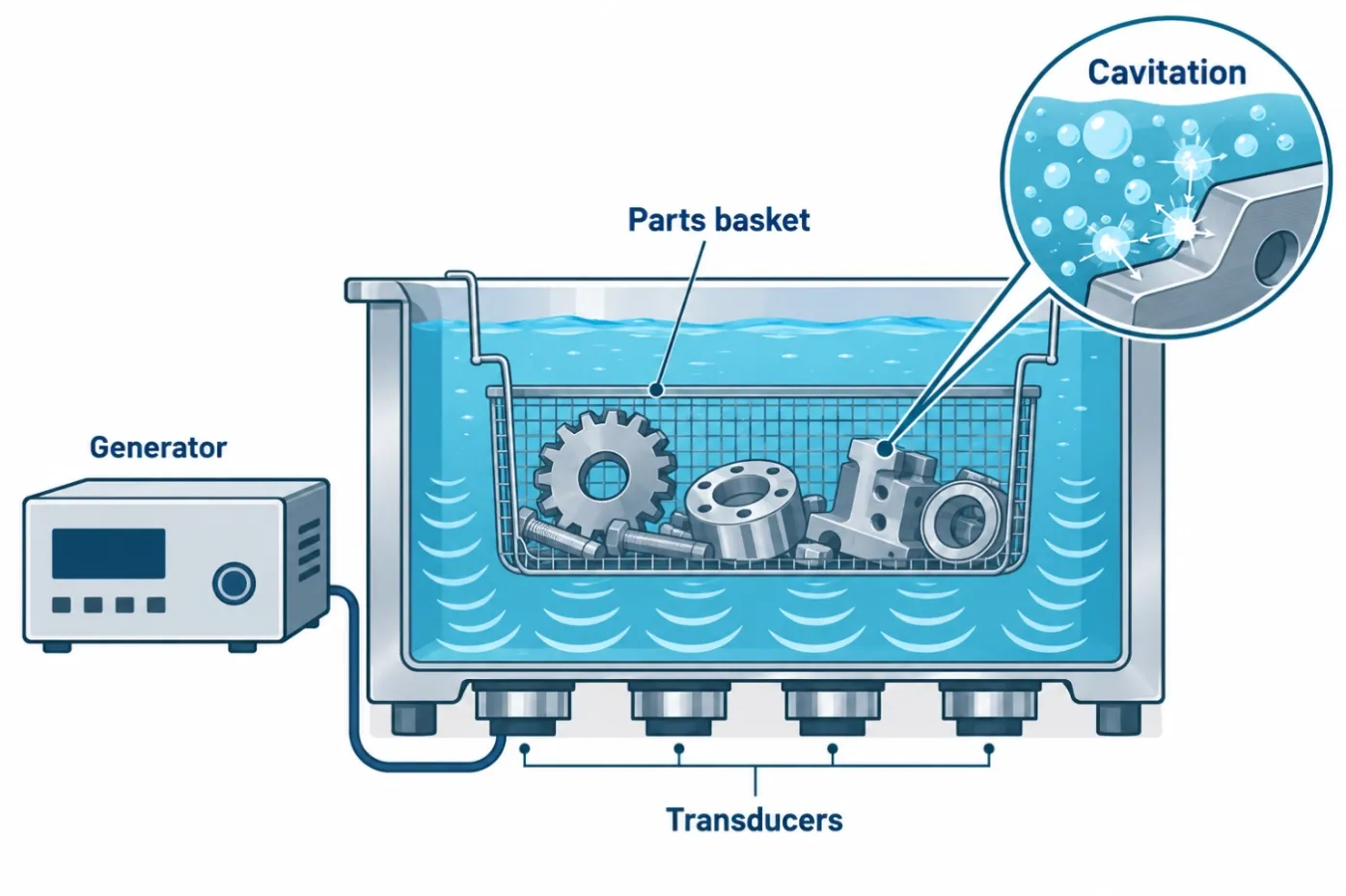
An ultrasonic cleaning system has three core elements: a tank filled with a water-based solution, transducers that vibrate the tank, and a generator that drives the transducers at ultrasonic frequencies — far above what human hearing picks up.
- The generator converts mains power into a high-frequency electrical signal, typically in the tens of kilohertz.
- Piezoelectric transducers bonded to the tank wall or bottom convert that signal into mechanical vibration, shaking the tank tens of thousands of times per second.
- During each rarefaction (pressure-drop) half-cycle, the liquid tears apart microscopically and forms millions of tiny vacuum bubbles.
- During the compression half-cycle, those bubbles collapse violently against nearby surfaces.
- Each collapse fires a microscopic jet of cleaning solution onto the part at very high local pressure — strong enough to dislodge oil films, chips, polishing paste and flux, but gentle enough to leave sound metal intact.
Because the bubbles form everywhere the liquid reaches, cavitation cleans where brushes and spray nozzles cannot: blind holes, threads, internal channels and gaps between stacked parts.
Frequency: Reference Table
Frequency decides bubble size, and bubble size decides cleaning character.
Frequency band | Cavitation behaviour | Best suited for |
|---|---|---|
25–40 kHz (low) | Fewer, larger bubbles; aggressive impact | Gross soils, chips and swarf, robust steel parts, heavy degreasing |
~40 kHz (standard) | Balanced energy and coverage | General industrial degreasing and pre-plating cleaning |
80–130 kHz (high) | Dense, fine, gentle bubbles | Precision parts, optics, electronics, delicate or polished surfaces |
Many industrial installations combine two frequencies in one tank — a low frequency to strip heavy soil, a high frequency for the final fine clean. [To be confirmed: ES-PRO ultrasonic equipment frequency range — replace with actual supported bands once confirmed.]
Power, Heat and Chemistry: The Other Three Levers
- Power density sets cavitation intensity — too little and cavitation weakens; excessive power concentrated in one zone can erode soft surfaces, which is why industrial tanks distribute transducers rather than just adding wattage.
- Temperature — warm solution cleans faster because it lowers surface tension and makes oils easier to lift. Degreasing is commonly run at moderately elevated temperature, often around 40–60 °C depending on the chemistry, controlled by a tank heater and thermostat.
- Cleaning chemistry — the detergent wets the soil, breaks down oils and keeps removed dirt suspended. Cavitation supplies the mechanical action; chemistry supplies the chemistry. Fresh solution also needs degassing (running the ultrasound briefly to drive out dissolved air) before it cleans at full strength.
Field Workflow: Sizing Power Density and the Cycle Checklist
A reusable sizing rule for comparing machines: power density = generator power (W) ÷ tank volume (L). Guideline working ranges by duty:
Duty | Guideline power density* |
|---|---|
Light particulate, rinse-stage cleaning | 10–15 W/L |
General degreasing and pre-plate cleaning | 20–25 W/L |
Heavy soils, fixtured dense loads | 25–40 W/L |
* Industry guideline ranges for orientation — final sizing follows the chemistry supplier's recommendation and the soil test on your actual parts.
Before running a production cycle, work through this checklist:
- ☐ Solution degassed (fresh baths need a short ultrasonic run first)
- ☐ Parts loaded so liquid reaches every surface — no nested flats
- ☐ Chemistry dosed to the datasheet concentration; temperature reached
- ☐ Frequency and time matched to soil (start short; extend based on result)
- ☐ Rinse stage ready — cleaning is only half of "clean"
Inside an Industrial Ultrasonic Machine
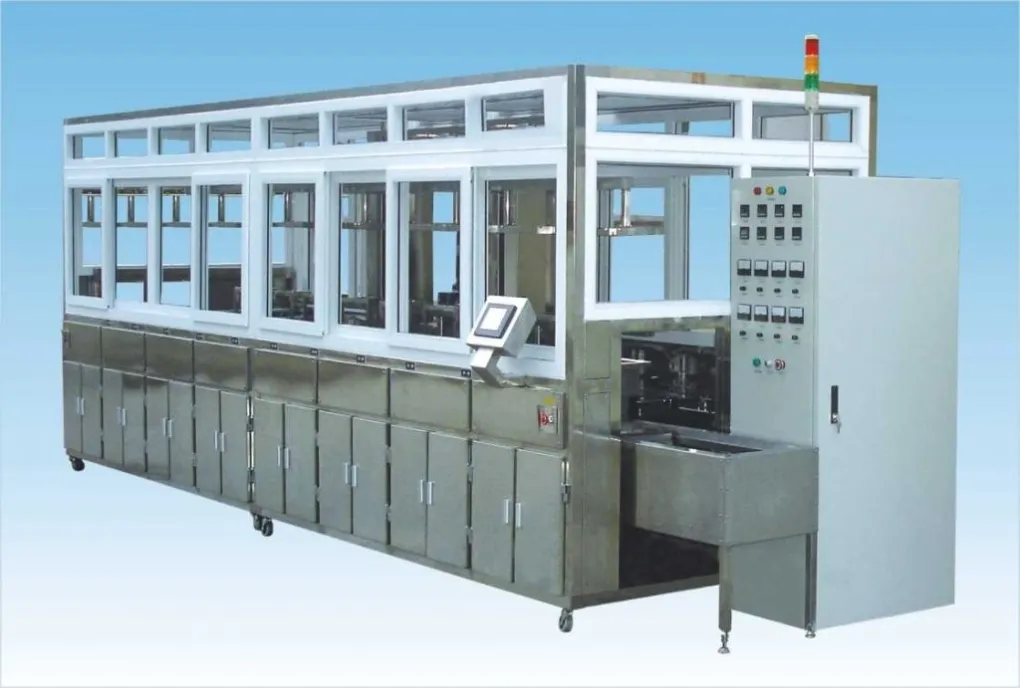
Compared with a benchtop unit, an industrial ultrasonic cleaning machine is a production tool: a stainless steel production tank sized for the real workpiece; a transducer system distributed for even cavitation across the whole tank; an ultrasonic generator with stable output (switchable or mixed bands on multi-frequency units); a heating system with thermostatic control sized for production loads; filtration and oil removal — pumps, filters and often an oil skimmer — so the bath keeps working through shifts; and handling (baskets, racks, hoists), with multi-tank lines chaining ultrasonic washing, rinsing and drying into one workflow.
What It Cleans Well — and What It Doesn't
It excels at: machined parts straight from cutting (oil plus chips in one step); pre-plating and pre-coating preparation, where adhesion demands a spotless surface; hydraulic, pneumatic and fuel-system components with internal passages; moulds, dies and heat exchangers with complex geometry; printed circuit boards and electronic assemblies with matched chemistry.
It is the wrong tool when: heavy rust or scale needs acid pickling; the part traps solution in closed cavities; or the material is so soft that cavitation itself can erode it at aggressive settings.
Industrial Tanks vs Benchtop Units
Aspect | Benchtop unit | Industrial machine |
|---|---|---|
Tank volume | A few litres | Tens to thousands of litres |
Duty cycle | Intermittent | Continuous multi-shift operation |
Filtration / oil removal | Usually none | Filtration, skimming, bath maintenance |
Handling | Manual basket | Racks, hoists, multi-stage lines |
Outcome focus | Looks clean | Verified cleanliness for the next process step |
That last row matters most in industry: for a plating line or an assembly shop, "clean" is a measured state the next process depends on, not an impression.
Standards and Evidence Boundary
For buyers who need references in specifications and purchase orders:
- ASTM A380 — Standard practice for cleaning, descaling and passivation of stainless steel parts, systems and equipment; ultrasonic cleaning is one of the recognized methods within such cleaning procedures. Common reference for stainless component cleaning specs.
- Chemistry supplier datasheets — detergent concentration, temperature range and dwell time are defined there; ultrasonic parameters are tuned to them.
Evidence boundary: this article states industry-general facts (cavitation physics, frequency behaviour, typical temperature ranges). Machine-specific parameters and cleaning-performance claims come from the equipment datasheet and a soil test on your parts — ES-PRO does not generalize them.
FAQ: What Operators Ask First
Do you need to heat an ultrasonic cleaner?
Not always, but heating makes degreasing significantly faster and more thorough. Most industrial tanks include a heater and thermostat, and oil-based soils are commonly cleaned warm at around 40–60 °C depending on the detergent. Light particulate cleaning can run cold.
What frequency should an ultrasonic cleaner use?
40 kHz is the general-purpose industrial default. Go lower (25–40 kHz) for heavy soils and robust parts, higher (80 kHz and above) for precision, polished or delicate components. Multi-frequency tanks cover both cases in one machine.
Can ultrasonic cleaning damage parts?
Only if parameters are wrong for the material. Aggressive low-frequency cavitation can erode soft metals such as aluminium or brass over long exposure. With the correct frequency, chemistry and cycle time, ultrasonic cleaning is safe for the vast majority of industrial components — including precision ones.
What liquid goes into an ultrasonic cleaner?
A water-based solution: purified water plus an ultrasonic detergent matched to the soil. Never run flammable solvents in a standard aqueous tank. And avoid tap water — its dissolved minerals leave spots on parts and scale the tank; see our comparison of distilled vs deionized water.
Related Reading
- Pillar guide: What Is Electroplating? — the definition, plating types and line anatomy behind many cleaning specs.
- Adjacent decision: Distilled vs Deionized Water for Ultrasonic Cleaners — which water to fill the tank with, and why.
- Next step: browse industrial ultrasonic cleaning machines to see tank sizes and configurations.
Diagnostic CTA: What to Send Us — and What You Get Back
To size a machine instead of guessing, send four inputs through our RFQ form:
- Your dirtiest parts — soil type (oil, chips, polishing paste, flux) and material
- Largest part size and weight per basket or fixture
- Required cleanliness level — "visually clean" or a specification for the next process step
- Throughput — parts per hour or baskets per shift
ES-PRO returns: a recommended tank size, frequency and power configuration, a chemistry-matched process proposal (wash–rinse–dry), a quotation, and an explicit list of any open questions — we state what is missing rather than assuming it.
References & Authorities
- ASTM A380/A380M — Cleaning, Descaling, and Passivation of Stainless Steel Parts, Systems, and Equipment — ASTM International.
- Chemistry supplier datasheets — detergent concentration, temperature range and dwell time for the specific cleaning chemistry.
- Industry associations — e.g., NASF (National Association for Surface Finishing, US) and IMF (Institute of Materials Finishing, UK) publish supplementary guidance and training for the surface-finishing industry.
- Standards are cited for identification; always use the current edition from the issuing body. Process parameters are governed by the datasheets for the specific chemistry.