
Oct 4, 2026Plating Lines & Equipment
How to Set Up a Metal Plating Line: Checklist
Planning an electroplating line? See the equipment checklist, automation options and key decisions before you buy — plus what to send for a layout proposal.
A planning guide for decision-makers: the five decisions that shape a line, the equipment checklist they produce, and what to send a supplier for a layout proposal. About an 8-minute read.
Written by Jason Han · Engineering reviewed by Eayon · Published 2 October 2026 · Updated 2 October 2026
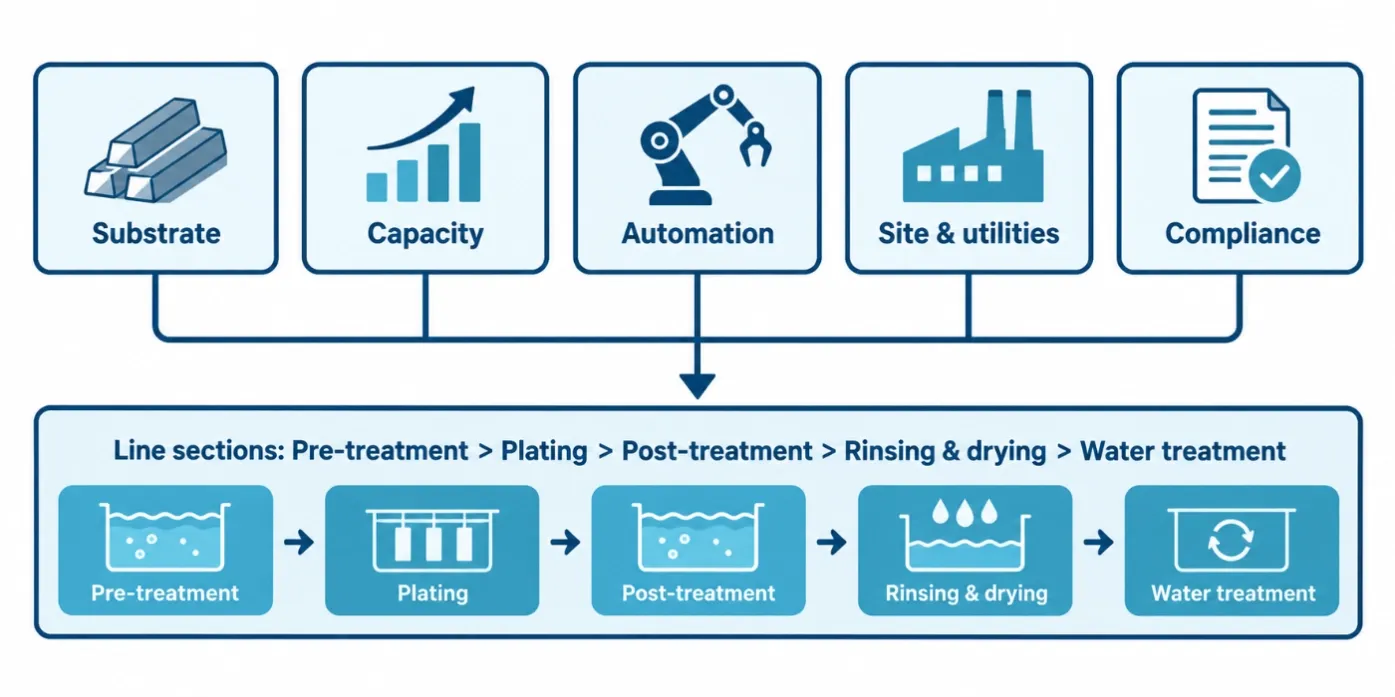
Setting up a metal plating line comes down to five decisions — substrate and coating, capacity and takt time, automation level, floor space and utilities, and wastewater compliance — and then assembling the line sections those decisions imply: pre-treatment, plating, post-treatment, rinsing and drying, and water treatment. Get the decisions right first; the equipment list follows.
The 5 Decisions That Shape the Whole Line
1. Substrate and coating system. What you plate onto, and with which metal and chemistry, drives everything technical: tank and liner materials, rectifier sizing, ventilation needs and process sequence. Plating zinc onto steel fasteners and plating nickel onto aluminium housings lead to two very different lines — decide this first, in writing, before comparing any quotations.
2. Capacity and takt time. How many parts per hour, at what size and weight, and per which load carrier (rack or barrel)? Capacity determines the number and size of tanks, the rectifier current, and whether manual transport can keep up. Size tanks for where production is going, not just where it is today.
3. Automation level. Manual, semi-automatic or fully automatic transport decides labour cost, consistency and throughput — the selection table below.
4. Floor space and utilities. Lines are long, heavy and wet: tank length plus handling clearance plus a maintenance aisle, floor loading for tanks full of solution, ceiling height for hoists, and power, water, drainage and compressed air at the right positions. Measure the hall before buying tanks — a line that fits on paper only is a classic failure.
5. Wastewater and fume compliance. Rinse water and spent baths need treatment before discharge, and plating fumes need scrubbing in most jurisdictions. Permits usually require the treatment plan up front — reserve space and budget for it from day one, because retrofitting water treatment into a finished hall costs far more than planning it in.
Plating Line Equipment Checklist
Whatever the coating system, most lines are assembled from these six sections:
Section | Typical equipment |
|---|---|
Pre-treatment | Soak / ultrasonic / electrolytic degreasing tanks, acid pickling, activation, rinse tanks |
Plating | Plating tanks with linings, plating rectifiers and DC busbars, filtration pumps, air agitation, heating or cooling (chillers / heat exchangers), temperature and level control |
Post-treatment | Neutralizing, passivation and anti-tarnish tanks |
Rinsing & drying | Multi-stage counterflow rinse tanks, hot-air or centrifugal dryers |
Water & environment | RO/DI water systems, wastewater treatment plant, fume scrubbers |
Handling & control | Racks and barrels, manual arms or automatic hoists (gate / side-arm type), PLC control, operator platforms |
Each section corresponds to equipment categories you can review under our plating lines and peripheral product ranges.
Field Calculation: Size the Rectifier Before the Tanks
One reusable check every buyer can run while comparing quotations — rectifier current from target current density:
I (A) = j (A/dm²) × A (dm² of cathode surface per load)
Worked example: a rack holds 20 parts, each with 2 dm² of surface to plate; target current density j = 5 A/dm² (typical for many nickel baths). Required current = 5 × 40 = 200 A. Add the standard engineering margin (rectifier runs comfortably at 80–90% of rating, so specify 250 A class) and check the voltage budget against bath resistance and busbar run.
Checklist before trusting any quotation's power figures:
- ☐ Cathode area per load counted from real part geometry, not catalogue guesses
- ☐ Current density matches the chemistry datasheet's window
- ☐ Rectifier rating includes headroom for thicker future specs
- ☐ Busbar cross-section and run length sized for the same current
Which Automation Level Fits Your Production?
Level | How it works | Best for |
|---|---|---|
Manual | Operators move racks/barrels between tanks on a fixed sequence | Lab scale, low volume, high product mix |
Semi-automatic | Powered assists and guided sequencing, operator still in the loop | Growing output on a limited budget |
Full automatic (gate / side-arm hoist) | Programmable hoists run the whole recipe unattended | Stable volume, repeatable quality, lower labour dependency |
Vertical lift | Vertical handling for a compact footprint | Space-limited plants |
Reel-to-reel | Continuous plating of strip and lead frames | Electronics strip stock at high volume |
VCP | Vertical continuous transport of panels | PCB panel production |
The choice is a trade-off of volume × product mix × labour cost × quality documentation requirements. As a rule of thumb: if two or more shifts run the same recipe on similar parts, automation pays for itself in consistency long before the labour savings; if every job is different, manual or semi-automatic stays flexible.
Common Setup Mistakes — and How to Avoid Them
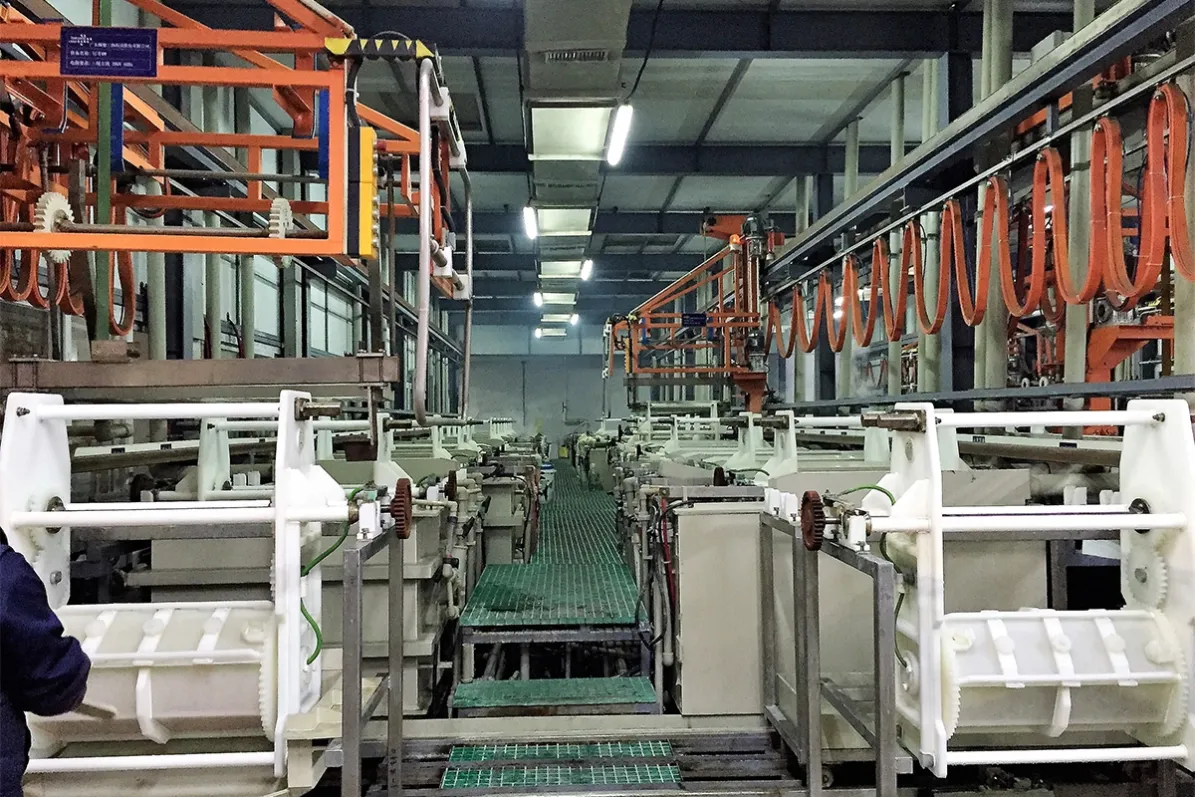
- Tank material mismatched to the chemistry. Every bath has its own temperature, acidity and aggressiveness; a liner that survives one chemistry will fail in another. Specify tank materials per bath, not per line.
- Rectifiers sized as an afterthought. The DC power supply must match bath geometry and target current density — and the busbar run to the tanks must not eat the voltage budget. Plan plating rectifiers and DC power supplies together with the tank layout.
- No space reserved for water treatment. The wastewater plant, DI-water system and their pipework need real floor area. Lines that leave this out end up buying space back at a premium.
- Underestimated floors and heights. Full tanks are extremely heavy, drains and pits need routing, and hoists need vertical clearance. Structural checks come before tank drawings.
What to Send Us for a Line Layout Proposal
A layout proposal starts with six inputs — the more precise your answers, the closer the first proposal lands:
- Substrate and part geometry — material, maximum dimensions and weight per load
- Coating system — plating metal and chemistry, or the performance target if chemistry is open
- Capacity target — parts per hour, or per shift/day
- Automation preference — manual, semi-automatic or fully automatic (or "advise us")
- Site constraints — hall dimensions, available utilities, floor situation
- Compliance requirements — local discharge and emission rules
ES-PRO returns: a proposed line configuration with tank sequence and automation level, an equipment list including rectification, filtration and water-treatment scope, a quotation, and an explicit list of any open questions. [To be confirmed: typical proposal-to-delivery timeline wording — no delivery-time claims until confirmed by the business.]
Standards and Evidence Boundary
Documents buyers commonly cite when specifying a line's output and its environmental boundary (always the current edition):
- ISO 2080 — Electroplating and related processes: vocabulary; the shared language for tank, process and equipment terms.
- ASTM B633 — Electrodeposited coatings of zinc on iron and steel, with thickness classes by service condition; the model for how a coating spec anchors a line's plating stage.
- US EPA Metal Finishing Effluent Guidelines (40 CFR Part 433) — the US regulatory reference for discharge limits from electroplating shops; a template for what local permits anywhere will ask about.
- Local discharge and emission permits — the actual legal boundary; the wastewater and scrubber scope of a line is sized against them.
Evidence boundary: this article gives planning-grade guidance only. Coating specs, chemistry windows and discharge limits come from the applicable standards, chemistry supplier datasheets and your local authority — not from this page.
FAQ: What Buyers Ask Before Quotations
How much floor space does a plating line need?
Enough for the full tank sequence plus handling clearance, a maintenance aisle, hoist headroom and the water-treatment footprint — in practice the line area and the water area are planned together from the start. A layout proposal with your part sizes and capacity target gives you the exact figure.
What information does a supplier need to quote a plating line?
Substrate and part geometry, coating chemistry, capacity target, automation preference, site constraints and compliance requirements — the six-item list above. Sending it complete typically cuts weeks off the quotation loop.
Should I start with a manual line and automate later?
Viable only if the manual line is designed for it: pit depths, power supply, tank spacing and layout must anticipate hoists and controls. Buying a manual line that cannot be upgraded is the expensive version; designing the upgrade path in is the cheap one.
Do I need wastewater treatment before installing a plating line?
Yes — plan it concurrently with the line, not after. Permits in most jurisdictions require the treatment concept up front, and rinse water flows from day one of production. It belongs in the initial budget and floor plan.
Related Reading
- Pillar guide: What Is Electroplating? — the process and coating types this line will execute.
- Adjacent decision: The Electroplating Process, Step by Step — what each tank in the sequence actually does.
- Next step: browse plating lines and tank systems to see automation levels and configurations.
Diagnostic CTA: What to Send Us — and What You Get Back
The six inputs above are the whole request. Send them through our RFQ form — or use the quick enquiry form at the end of this article — and ES-PRO returns: a line configuration (tank sequence, automation level, tank and rectifier sizing), an equipment list across all six sections, a quotation, and an explicit list of open questions. We state what is missing rather than assuming it.
References & Authorities
- ISO 2080 — Electroplating and related processes: vocabulary — International Organization for Standardization (ISO).
- ASTM B633 — Electrodeposited coatings of zinc on iron and steel — ASTM International.
- US EPA Metal Finishing Effluent Guidelines (40 CFR Part 433) — United States Environmental Protection Agency (EPA).
- Chemistry supplier datasheets — bath systems, concentrations and operating windows for specific plating chemistries (issued by the chemistry supplier).
- Industry associations — e.g., NASF (National Association for Surface Finishing, US) and IMF (Institute of Materials Finishing, UK) publish supplementary guidance and training for the surface-finishing industry.
Standards are cited for identification; always use the current edition from the issuing body. Process parameters are governed by the datasheets for the specific chemistry.