
Oct 4, 2026Plating Lines & Equipment
What Equipment Is Needed for Electroplating?
The equipment behind an electroplating line: tanks, rectifiers, cleaning stages, handling, filtration, water treatment — see what each part does.
An electroplating line needs five equipment groups in one sequence: pre-treatment, plating tanks with DC power, post-treatment, rinsing and drying, and water treatment. About a 7-minute read.
Handling and control tie them together — manual arms for lab scale, automatic hoists and PLC recipes for production.
Written by Mia Shang · Engineering reviewed by Li Wang · Published 3 October 2026 · Updated 3 October 2026
The Core Equipment Categories
1. Pre-treatment and cleaning. Soak degreasing tanks, ultrasonic cleaning or electrolytic cleaning stations, acid pickling and activation baths. Pre-treatment quality decides adhesion — most coating failures start here, so this group is never the place to economize.
2. Plating tanks and DC power. The plating cells themselves — tanks lined for the chemistry, with plating rectifiers converting mains AC to controlled DC, sized from cathode area and current density. Anode systems, air or mechanical agitation and continuous filtration keep the bath uniform; heating or chillers hold the temperature window.
3. Post-treatment. Neutralizing, passivation or anti-tarnish dips depending on the coating system, plus any seal or conversion stage the specification requires.
4. Rinsing and drying. Multi-stage counterflow rinse tanks (fresher water in the later stages), then hot-air or centrifugal dryers. Rinsing protects downstream baths and delivers spot-free surfaces — see the electroplating process step by step for how the stages connect.
5. Water treatment. RO/DI water systems for rinse quality and make-up water, and wastewater treatment sized to the rinse loads — in most jurisdictions this is a permit requirement, not an option.
Handling and control ties the groups together: manual arms for lab-scale and low-volume work, or automatic plating lines with gate/side-arm hoists, PLC control and recipe management for production.
How the List Scales with Ambition
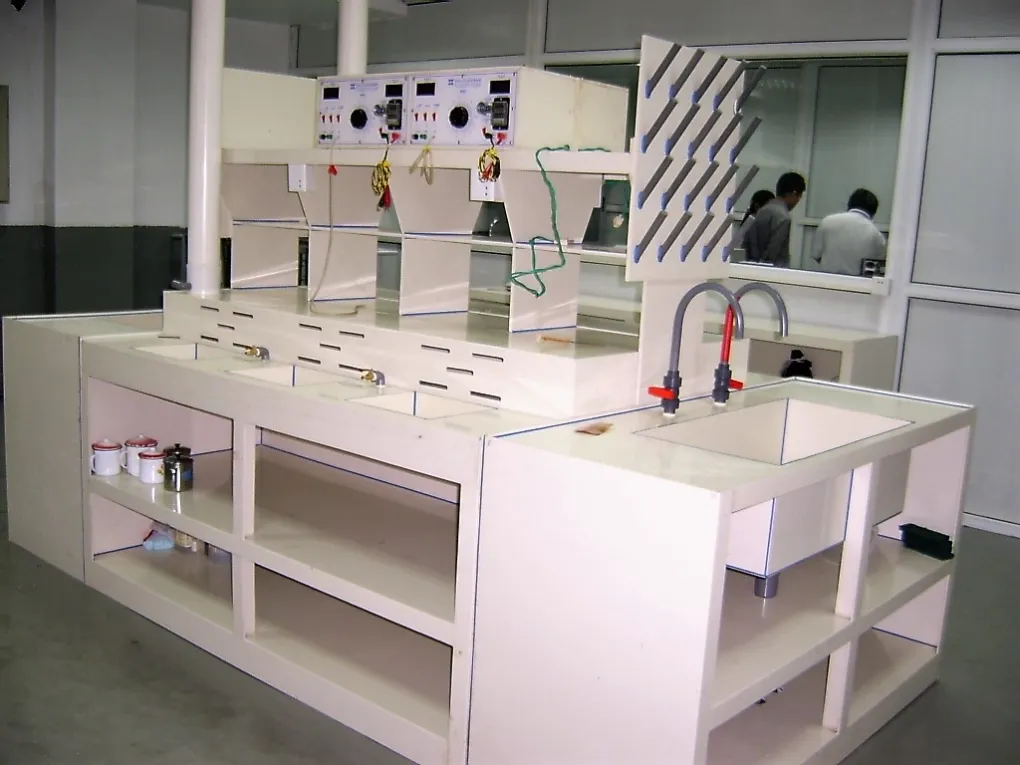
A manual lab-scale line can run the full process with a handful of tanks, one rectifier and manual handling — the standard starting point for R&D and small batches. A production line adds automatic transport, multiple rectifiers with computerised control, chemical dosing systems, and environmental equipment (fume scrubbers, oil separation). The categories never change; the engineering behind each one does.
Standards and Evidence Boundary
- ISO 2080 — the vocabulary standard that names these equipment categories consistently across suppliers and audits.
- Coating specifications (e.g., ASTM B633 for zinc on steel) — they define what the equipment must achieve, and therefore what to size.
- Local permits — wastewater and fume treatment scope is bounded by local regulations.
Evidence boundary: this article lists equipment categories at industry-general level. Sizing, materials of construction and chemistry compatibility come from your parts, throughput and the chemistry supplier — not from this page.
FAQ
What is the minimum equipment to start electroplating?
A manual line needs: pre-treatment tanks (clean, pickle, activate), one plating tank with a rectifier, rinse tanks, a drying method, and a plan for wastewater. Everything else — automation, dosing, scrubbers — scales with production volume.
Do I need a rectifier for every plating tank?
Each plating cell that runs its own current needs its own rectifier output (or a properly engineered shared supply). A multi-process line typically runs one rectifier per plating tank so each chemistry keeps its own current density window.
Is ultrasonic cleaning required, or is soaking enough?
Depends on the soil: light oils may come out with soak cleaning, while chips, polishing paste and blind-hole contamination usually need ultrasonic agitation. Judge it from your dirtiest part, not from the catalog.
Who designs the tank sequence?
The line supplier engineers it from your parts, chemistry and throughput — which is why quotations start with your drawings rather than a price list.
Related Reading
- Pillar guide: The Electroplating Process, Step by Step — the sequence this equipment executes.
- Adjacent decision: How to set up a metal plating line — the decisions behind sizing each category.
- Next step: browse plating line equipment — every category above maps to a product range.
Diagnostic CTA: What to Send Us — and What You Get Back
Send your parts, substrate, coating target and planned throughput through our RFQ form. ES-PRO returns: an equipment list covering all five categories, a line layout proposal, a quotation, and an explicit list of open questions — we state what is missing rather than assuming it.
References & Authorities
- ISO 2080 — Electroplating and related processes: vocabulary — International Organization for Standardization (ISO).
- ASTM B633 — Electrodeposited coatings of zinc on iron and steel (example coating specification) — ASTM International.
- Local discharge and emission permits — wastewater and fume treatment scope is bounded by local regulations (issued by the local authority).
- Industry associations — e.g., NASF (National Association for Surface Finishing, US) and IMF (Institute of Materials Finishing, UK) publish supplementary guidance and training for the surface-finishing industry.
Standards are cited for identification; always use the current edition from the issuing body. Process parameters are governed by the datasheets for the specific chemistry.