
Oct 4, 2026Applications
Electrolytic vs Electroless Nickel Plating
Electrolytic and electroless nickel plating need different lines. Compare how each works, where each fits, and what equipment to budget for.
Electrolytic nickel uses DC current from rectifiers; electroless nickel deposits nickel-phosphorus by autocatalytic chemical reduction that needs no current at all. About an 8-minute read.
The choice changes your tank mix, power equipment and quality checks — decide it before buying a line.
Written by Jason Han · Engineering reviewed by Eayon · Published 2 October 2026 · Updated 2 October 2026
How Each Process Works
Electrolytic nickel plating is classic electroplating: the part is the cathode, nickel anodes (or insoluble anodes) sit in the bath, and a plating rectifier drives DC current through the cell. Metal deposits only where current flows, so current density control, anode placement and jigging decide coating distribution.
Electroless nickel plating (EN) is a chemical process: the bath contains nickel ions and a reducing agent (typically sodium hypophosphite), and nickel-phosphorus deposits wherever the properly activated surface touches the solution — no external current. Because deposition is chemical, coating thickness is uniform even inside deep bores and on complex geometry, which is exactly where electrolytic nickel struggles.
The phosphorus content of the deposit (roughly low, medium and high phosphorus grades are available in industry) is set by the bath chemistry and drives hardness and corrosion behaviour — your chemistry supplier's datasheet governs the specifics.
Comparison Table
Aspect | Electrolytic nickel | Electroless nickel |
|---|---|---|
Deposition driver | DC current from rectifiers | Autocatalytic chemical reduction |
Thickness distribution | Follows current density; thickness varies with part geometry | Very uniform, including bores and internal surfaces |
Substrate | Must be electrically conductive | Conductive and properly activated non-conductors (with process support) |
Deposit composition | Pure nickel (Watts/sulfamate-type baths) | Nickel-phosphorus alloy |
Speed control | Current density and time | Bath temperature, pH and chemistry control |
Typical equipment | Rectifiers, anodes, filtration, agitation | Heated tanks with tight temperature control, filtration, continuous carbon treatment |
Watch-outs | Burning at high current density, throw power in recesses | Bath stability and plate-out management, replenishment control |
Where Each Process Fits
Choose electrolytic nickel when: you need bright or decorative nickel as an underlayer (nickel-chrome systems); you plate simple geometry where current distribution is manageable; you want the fastest possible deposition per ampere and already run rectified lines; or sulfamate-type pure-nickel deposits are specified for engineering builds.
Choose electroless nickel when: parts have complex geometry, deep holes or threads that need uniform thickness; corrosion resistance with a consistent nickel-phosphorus layer is the goal; the shop cannot guarantee uniform current density across the load; or specifications call for EN properties explicitly.
Many plants run both on separate lines — EN for geometry-critical work, electrolytic nickel for decorative and thick-build work.
Equipment Each Process Needs
An electrolytic nickel line is built around DC power: plating rectifiers sized from cathode area and current density, anode or insoluble-anode systems, solution agitation and filtration, and the usual pre-treatment and rinse stages.
An electroless nickel line removes the rectifiers but tightens everything thermal and chemical: EN baths run at elevated temperature with tight tolerance, so tank heating and control matter more; bath loading (surface area per litre) must stay inside the supplier's window; and continuous filtration plus replenishment control keep the autocatalytic bath stable.
Both are tank-sequence lines at heart — see our overview of plating lines for how the sections assemble.
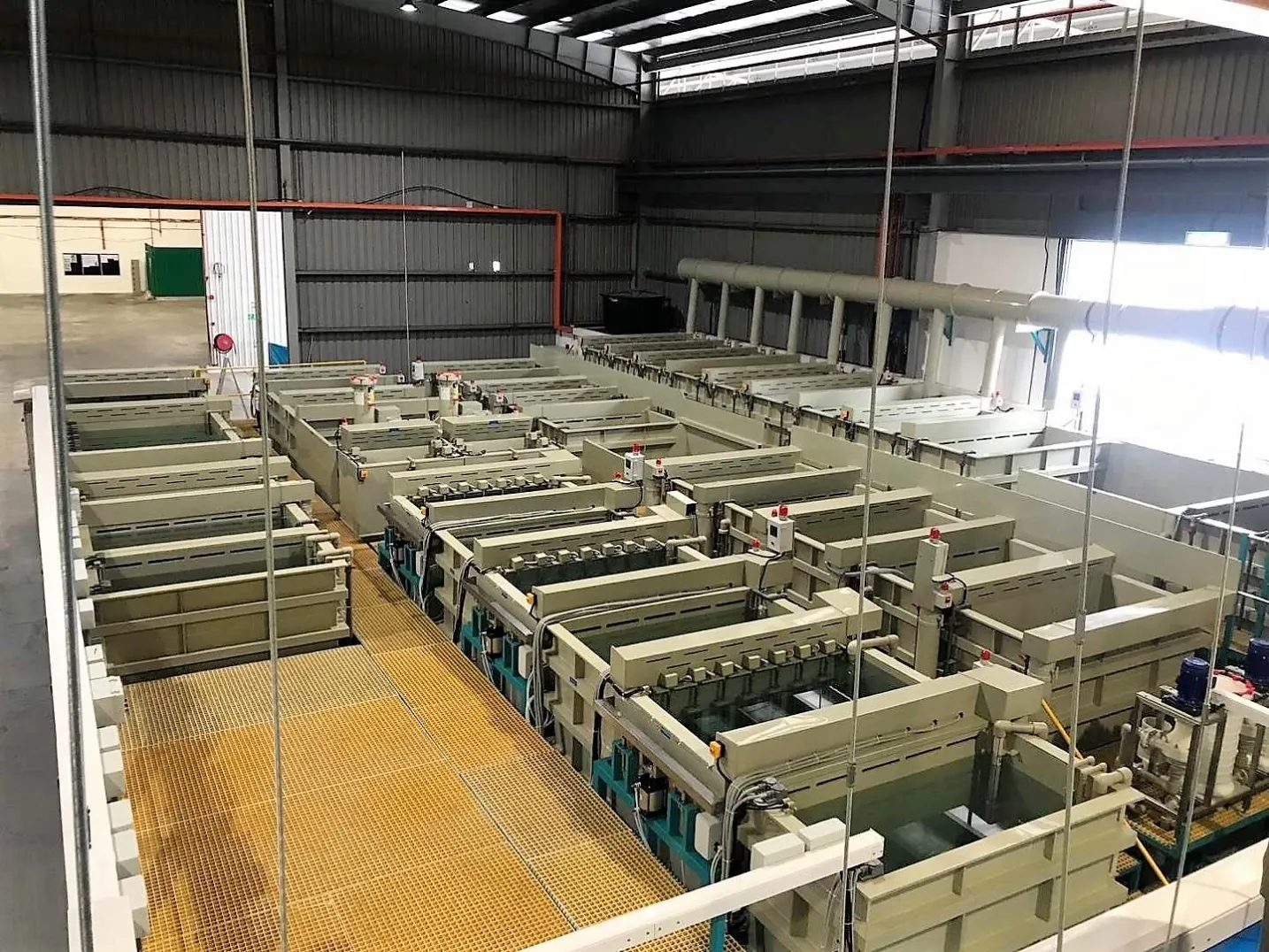
Standards and Evidence Boundary
- ISO 4527 — autocatalytic (electroless) nickel-phosphorus coatings; the reference specification for EN requirements.
- ASTM B689 — electrodeposited engineering nickel coatings; the model for electrolytic nickel specs.
- Chemistry supplier datasheets — phosphorus grade, bath loading, temperature and replenishment windows are defined there, not by the line builder.
Evidence boundary: this article compares the two processes at industry-general level. Deposit properties, bath windows and approval requirements come from the applicable standard and your chemistry supplier — not from this page.
FAQ
Is electroless nickel really plating if no current is used?
Yes — it is electrode-less plating: nickel deposits chemically through autocatalytic reduction. The line looks different (no rectifiers), but it is still a tank-sequence plating process with pre-treatment, plating and rinsing stages.
Which nickel process gives better corrosion protection?
Neither universally. Electroless nickel's uniform thickness on complex geometry often wins on real parts, while electrolytic nickel thickness and performance depend on current distribution. Judge against the coating specification and the part geometry — not the process name.
Can one line run both processes?
No. The bath chemistries and equipment are different: electrolytic nickel needs rectifiers and anode systems; electroless nickel needs tightly controlled heated tanks. Plants that need both run separate lines or separate tank sets.
Which is cheaper to set up?
It depends on the parts and the specification: EN removes rectifier cost but adds thermal control and bath management; electrolytic nickel needs DC power but simpler bath control. Send your parts and target thickness for a line-level comparison instead of guessing from process prices.
Related Reading
- Pillar guide: What Is Electroplating? — where nickel sits among the common plating metals.
- Adjacent decision: Setting up a metal plating line — the five decisions behind any nickel line.
- Next step: browse plating lines to see line formats for nickel applications.
Diagnostic CTA: What to Send Us — and What You Get Back
Send four inputs through our RFQ form: your parts (geometry, size, substrate), the nickel process or property target, required thickness and corrosion spec, and your throughput. ES-PRO returns: a recommended line concept for the chosen nickel process, the equipment list including rectification or thermal scope, a quotation, and an explicit list of open questions — we state what is missing rather than assuming it.
References & Authorities
- ISO 4527 — Autocatalytic (electroless) nickel-phosphorus alloy coatings — International Organization for Standardization (ISO).
- ASTM B689 — Electrodeposited engineering nickel coatings — ASTM International.
- Chemistry supplier datasheets — phosphorus grade, bath loading, temperature and replenishment windows are defined by the chemistry supplier.
- Industry associations — e.g., NASF (National Association for Surface Finishing, US) and IMF (Institute of Materials Finishing, UK) publish supplementary guidance and training for the surface-finishing industry.
Standards are cited for identification; always use the current edition from the issuing body. Process parameters are governed by the datasheets for the specific chemistry.